
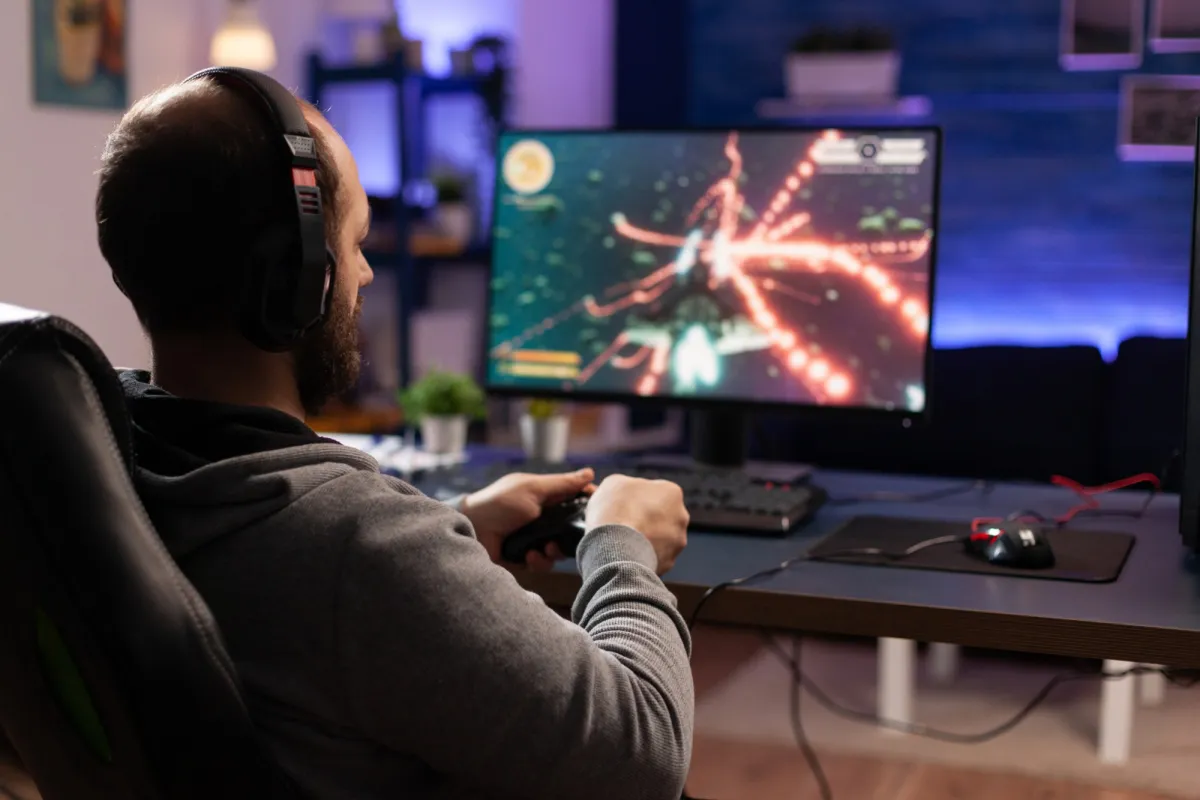


The short answerGaming addiction is recognised by the World Health Organization as gaming disorder: gaming you cannot control, that takes priority over the rest of life, and that carries on despite the harm it causes, usually for a year or more.[1] It is treatable. At Rooh Mind Care, psychiatrist Dr Himabindu Munagala (MBBS, MD Psychiatry, Karnataka Medical Council 169701) offers counselling for online gaming addiction, for young people, adults and the families around them, by secure video: ₹650 for a 30-minute psychiatric consultation, or ₹1,650 for a 50-minute therapy session.
At a glance
- A recognised condition: gaming disorder is in the WHO’s ICD-11, code 6C51.[2]
- Most gamers are fine: it affects a small share of people who play, so a lot of gaming is not, on its own, a disorder.[1][3]
- Who you would see: Dr Himabindu, a psychiatrist who also offers therapy sessions, including counselling for online gaming addiction.
- Two ways to start: a psychiatric consultation (₹650, 30 minutes) to understand what is going on, or therapy sessions (₹1,650, 50 minutes; packages of 4, 8 or 16).
- Families welcome: a parent or guardian joins for anyone under 18, and family members can join adult sessions with consent.
- How you are seen: online, by secure video, anywhere in India.
A lot of gaming, or gaming disorder?
Plenty of people game for hours and are fine: they sleep, study or work, see friends and can stop when they need to. Researchers have warned against treating heavy involvement in an ordinary hobby as an addiction on its own; what matters is lasting harm to daily life.[4] In large international surveys, more than two out of three people who played games reported no symptoms of a gaming problem at all.[3]
The WHO’s International Classification of Diseases (ICD-11) describes gaming disorder as a pattern of gaming, online or offline, with impaired control, increasing priority given to gaming over other interests and daily activities, and gaming that continues or escalates despite negative consequences. The pattern has to be severe enough to cause significant impairment in personal, family, social, educational or work life, and is normally evident for at least 12 months, although a shorter period can be enough when the symptoms are severe.[2][1]
The American Psychiatric Association’s DSM-5-TR lists internet gaming disorder as a condition for further study rather than an official diagnosis, with nine proposed criteria, such as preoccupation with gaming, losing interest in other activities and lying about how much one plays; five or more in a 12-month period suggest a problem.[5][6] Either way, the question in a consultation is the same: is gaming harming this person’s life, and what would help.
The signs to look for
The three features in the WHO definition, in everyday terms:[1]
Control has slipped
Promising “one more game” and playing until 3 am. Trying to cut down and not managing it. Anger, or a fight, when the device is taken away.
Gaming comes first
Meals, sleep, classes, work, friends and old hobbies are dropped to make time to play.
It carries on despite the harm
Marks falling, a job at risk, arguments at home, money spent on games, and the gaming goes on, or grows.
One sign on its own, for a few weeks, is common, especially in exam season or holidays. A pattern of all three that has lasted months, and is getting in the way of life, is a reason to talk to someone.
How common it is
A review of 53 studies with more than 226,000 people in 17 countries put the worldwide rate of gaming disorder at about 3%, or about 2% when only the most carefully sampled studies were counted.[7] Rates were higher in studies of adolescents, and the condition was found about two and a half times as often in males as in females.[7] Girls and women can still have it, and are easier to miss.
What often comes with it
Gaming problems rarely arrive alone. Studies have repeatedly linked gaming disorder with anxiety, depression, ADHD symptoms, social anxiety and obsessive-compulsive symptoms, although it is often not clear which came first.[8] For some people, gaming is where they go to escape low mood, loneliness or pressure; for others, the gaming came first and the low mood followed.
That is one reason to start with a psychiatrist: Dr Himabindu looks at the whole picture, including sleep, mood, worry, attention, substance use and safety, and not only the hours on a screen.
How Dr Himabindu helps
Dr Himabindu is a psychiatrist who also offers therapy sessions. During her MD in Psychiatry at K S Hegde Medical Academy, Mangaluru, she trained in de-addiction and addiction medicine and in child and adolescent psychiatry, and she offers counselling for online gaming addiction. She is a Senior Resident Doctor at Shadan Institute of Medical Sciences, Hyderabad, with more than four years in psychiatry, and sees Rooh Mind Care clients online.
A consultation to understand what is happening
A 30-minute psychiatric consultation: how much and when the person plays, what has changed at home, school or work, sleep, mood, worry, attention, any alcohol or other substances, and safety. You leave with her view of what is going on and a plan.
Counselling sessions
50-minute therapy sessions with her: working out what the gaming does for the person, the triggers and routines around it, a realistic plan for gaming and sleep, getting back to study, work and friends, and what to do after a slip.
The family, alongside
Families are welcome to join. For anyone under 18, a parent or guardian joins the consultation. In one trial with adolescents, six sessions of therapy with parents and teenagers together reduced internet addiction, partly through better parent and child communication.[9]
Medicine only where it helps
No medicine is an established treatment for gaming disorder itself.[10] Where depression, anxiety, ADHD or sleep problems sit underneath, treating them can matter; in one small study of children with ADHD who played internet games, eight weeks of ADHD medication was followed by less time online.[11] Some ADHD medicines are controlled drugs that cannot be prescribed online in India; if one is needed, she will say so and help you arrange an in-person appointment.[12]
Prefer to see a psychologist? Our psychologists also work with teenagers, young adults and families: see adolescent and young adult therapy and family therapy, or use Help me choose.
What the research says about treatment
Cognitive-behavioural therapy (CBT) has the most research behind it. A review of 12 CBT studies found that it clearly reduced gaming disorder symptoms and depression, and moderately reduced anxiety, by the end of treatment. The studies were too small to say whether it cut actual time spent gaming, and the gains at later follow-up were not statistically significant.[13]
Reviews of the wider treatment research have found it still small and uneven, with few well-controlled trials, so no treatment can yet be called proven.[14][10] We say this plainly because it shapes how care is planned: progress is reviewed as you go, the plan is adjusted, and family support is part of it where it helps.
For parents: before you book
- Pick a calm moment to talk, not the middle of a fight over the phone or console.
- Notice what has changed: sleep, meals, marks, friends, mood, money spent. A few notes help the consultation.
- Ask what the game gives them: friends, a sense of being good at something, a break from pressure. The answer often points to what needs to change.
- If they will not come, message us on WhatsApp and we will suggest how to start.
When it cannot wait
If someone is talking about harming themselves, has become violent, or has stopped eating or sleeping for days, do not wait for an online appointment. Call 112 or the free 24×7 helpline Tele-MANAS 14416.
How much does treatment cost, and how do I book?
30 minutes · online₹650
50 minutes · online · packages of 4, 8 or 16₹1,650
Fees are shown in full before you pay, with no hidden charges. See all fees →
- Choose a time with Dr Himabindu and pay online.
- You receive a private video link. Join from a quiet place on a phone or laptop; a parent joins for anyone under 18.
- She takes a history, asks about mood, sleep and safety, and agrees a plan with you: therapy sessions, treatment for anything underneath, or in-person care if that is what is needed.
Online consultations follow India’s Telemedicine Practice Guidelines, 2020.[12][15] What an online consultation can and can’t cover.
Privacy
What is said in a session stays between the client and the doctor. We do not contact a client’s school, college or employer. For teenagers, the doctor agrees clear rules with the family about what parents are told. The rare exceptions, such as a serious risk of harm, are set out in our privacy and confidentiality policy.
Compare every fee on how much therapy costs in India.
Gaming addiction: common questions
Is gaming addiction a real diagnosis?
Yes. The World Health Organization includes gaming disorder in the ICD-11 (code 6C51): gaming with impaired control, that takes priority over other activities, and that continues despite harm, usually for at least 12 months. The American Psychiatric Association lists internet gaming disorder in the DSM-5-TR as a condition for further study.
How many hours of gaming is too much?
There is no single number. Gaming disorder is defined by loss of control and harm to daily life, not by hours alone. Someone who games a lot but sleeps, studies or works and keeps their relationships may not have a problem; someone who games less but cannot stop and is failing at school may.
Does my child have to stop gaming completely?
Not necessarily. The aim is gaming that no longer runs the day. The plan is worked out with the young person and the family in sessions, rather than imposed in one go.
Will Dr Himabindu prescribe medicine for gaming addiction?
No medicine is an established treatment for gaming disorder itself, so counselling is the main treatment. If depression, anxiety, ADHD or a sleep problem is also present, she may suggest treating it, and explains the reasons and side effects first. Some controlled medicines cannot be prescribed online in India; if one is needed, she will help you arrange an in-person appointment.
Does she see adults with gaming problems too?
Yes. She sees adults as well as children and teenagers, and treats addiction of all kinds, including alcohol, tobacco and other substances alongside gaming.
How much does it cost?
₹650 for a 30-minute psychiatric consultation, and ₹1,650 for a 50-minute therapy session, with packages of 4, 8 or 16 therapy sessions at a lower fee per session. The full fee is shown before you pay.
Is it online only?
Yes. Dr Himabindu sees Rooh Mind Care clients online, by secure video, from anywhere in India. If someone needs to be seen in person, she will say so and help you arrange it.
Which languages does she speak?
Telugu, Kannada, Hindi and English. Families can move between languages in the same session.
How can I check Dr Himabindu’s registration?
Her Karnataka Medical Council registration number is 169701. You can search for it on the National Medical Commission’s Indian Medical Register.
Book a consultation with Dr Himabindu
₹650 for 30 minutes, online, in Telugu, Kannada, Hindi or English. Or ask us your questions on WhatsApp first.
Clinical references
Journal articles were matched to their Crossref and PubMed records, and official guidance to the issuing body's own page, on 14 November 2026. Research describes groups of people on average; it cannot promise any one person a particular result.
- World Health Organization. Addictive behaviours: Gaming disorder (questions and answers). 2020. who.int
- World Health Organization. ICD-11 for Mortality and Morbidity Statistics: 6C51 Gaming disorder. 2025. icd.who.int
- Przybylski AK, Weinstein N, Murayama K. Internet Gaming Disorder: Investigating the Clinical Relevance of a New Phenomenon. American Journal of Psychiatry. 2017;174(3):230–236. doi:10.1176/appi.ajp.2016.16020224
- Kardefelt-Winther D, Heeren A, Schimmenti A, van Rooij A, Maurage P, Carras M, et al. How can we conceptualize behavioural addiction without pathologizing common behaviours? Addiction. 2017;112(10):1709–1715. doi:10.1111/add.13763
- American Psychiatric Association. Diagnostic and Statistical Manual of Mental Disorders, Fifth Edition, Text Revision (DSM-5-TR). American Psychiatric Association Publishing; 2022. doi:10.1176/appi.books.9780890425787
- Petry NM, Rehbein F, Gentile DA, Lemmens JS, Rumpf H, Mößle T, et al. An international consensus for assessing internet gaming disorder using the new DSM-5 approach. Addiction. 2014;109(9):1399–1406. doi:10.1111/add.12457
- Stevens MW, Dorstyn D, Delfabbro PH, King DL. Global prevalence of gaming disorder: A systematic review and meta-analysis. Australian & New Zealand Journal of Psychiatry. 2021;55(6):553–568. doi:10.1177/0004867420962851
- González-Bueso V, Santamaría J, Fernández D, Merino L, Montero E, Ribas J. Association between Internet Gaming Disorder or Pathological Video-Game Use and Comorbid Psychopathology: A Comprehensive Review. International Journal of Environmental Research and Public Health. 2018;15(4):668. doi:10.3390/ijerph15040668
- Liu QX, Fang XY, Yan N, Zhou ZK, Yuan XJ, Lan J, et al. Multi-family group therapy for adolescent Internet addiction: Exploring the underlying mechanisms. Addictive Behaviors. 2015;42:1–8. doi:10.1016/j.addbeh.2014.10.021
- Zajac K, Ginley MK, Chang R, Petry NM. Treatments for Internet gaming disorder and Internet addiction: A systematic review. Psychology of Addictive Behaviors. 2017;31(8):979–994. doi:10.1037/adb0000315
- Han DH, Lee YS, Na C, Ahn JY, Chung US, Daniels MA, et al. The effect of methylphenidate on Internet video game play in children with attention-deficit/hyperactivity disorder. Comprehensive Psychiatry. 2009;50(3):251–256. doi:10.1016/j.comppsych.2008.08.011
- Board of Governors in supersession of the Medical Council of India. Telemedicine Practice Guidelines: enabling registered medical practitioners to provide healthcare using telemedicine. Ministry of Health and Family Welfare, Government of India. 2020. mohfw.gov.in
- Stevens MWR, King DL, Dorstyn D, Delfabbro PH. Cognitive–behavioral therapy for Internet gaming disorder: A systematic review and meta-analysis. Clinical Psychology & Psychotherapy. 2019;26(2):191–203. doi:10.1002/cpp.2341
- King DL, Delfabbro PH, Wu AMS, Doh YY, Kuss DJ, Pallesen S, et al. Treatment of Internet gaming disorder: An international systematic review and CONSORT evaluation. Clinical Psychology Review. 2017;54:123–133. doi:10.1016/j.cpr.2017.04.002
- Math SB, Manjunatha N, Kumar CN, Basavarajappa C, Gangadhar BN. Telepsychiatry Operational Guidelines 2020. NIMHANS, Bengaluru, with the Indian Psychiatric Society and Telemedicine Society of India. 2020. nimhans.co.in