
The short answerSocial anxiety disorder, also called social phobia, is an intense fear of being watched, judged or embarrassed in social situations, strong enough that you avoid them or get through them in great distress, and that it gets in the way of study, work or relationships.[1] It is not just shyness, and it responds well to the right treatment: the best-supported first choice is individual cognitive behavioural therapy (CBT) built for social anxiety.[2][3] At Rooh Mind Care you can start with a 50-minute online session with a qualified psychologist, and bring in a psychiatrist if medicine may help.
At a glance
- What it is: a persistent fear of being negatively judged in social situations, which are avoided or endured with intense distress.[1]
- Same thing, two names: “social phobia” is the older term for social anxiety disorder.
- How common: about 4% of people have it at some point in life worldwide.[4] India’s national survey found 0.47% currently affected, about 65 lakh adults, with an 82% treatment gap.[5]
- What helps first: individual CBT designed for social anxiety, not general advice to “just relax”.[2]
- Start here: a 50-minute online therapy session from ₹1,650the fee shown before you book; message us on WhatsApp first if a call feels like too much.
The spotlight is brighter from the inside
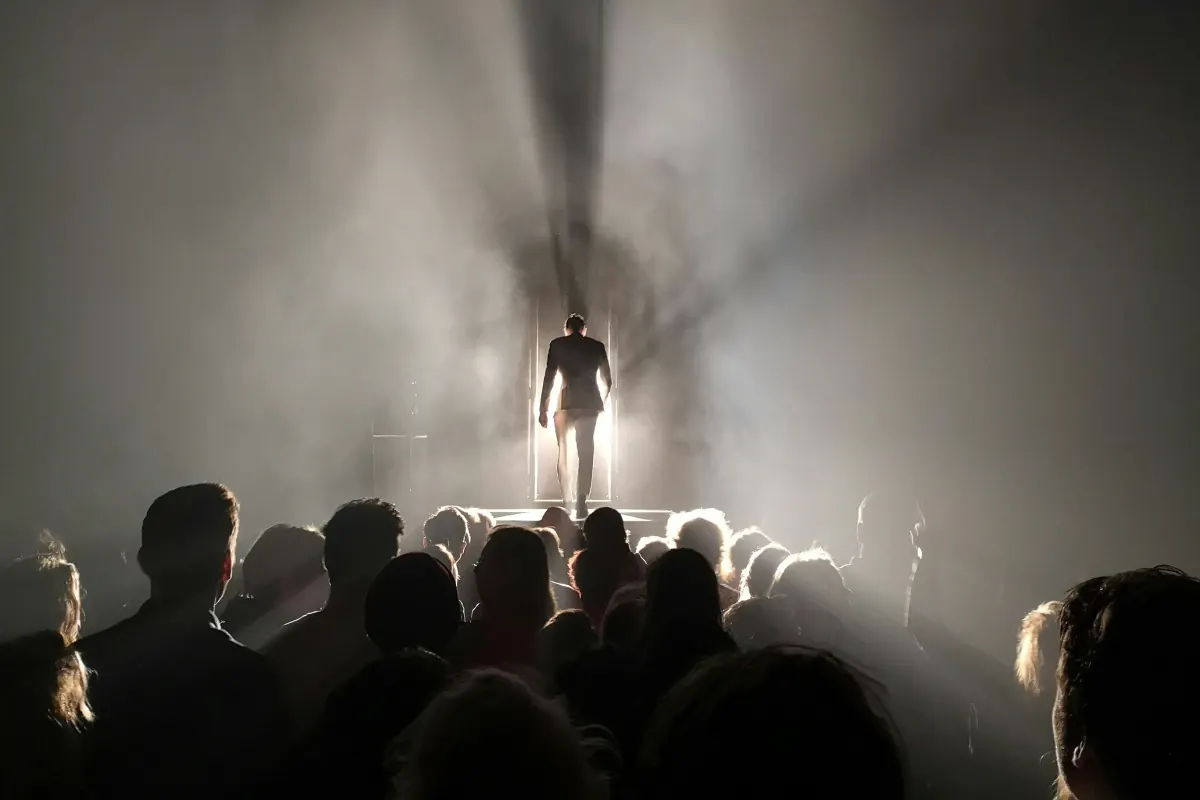
Look at the picture above. One figure in a spotlight, a whole audience watching. That is how a social moment can feel from the inside: your voice, your blush, your pause, all lit up. A famous experiment suggests the light is dimmer for everyone else. Students who were made to wear an embarrassing T-shirt into a room predicted that far more people would remember what was on it than actually did, and people in group discussions overestimated how noticeable their own remarks were.[6] The researchers call it the spotlight effect: we anchor on our own vivid experience and do not adjust enough for how others see us.
From the inside
- My heart is pounding and everyone can tell.
- My voice shook. They will remember that.
- I said something stupid. I must have looked ridiculous.
What the research suggests
- People tend to overestimate how many others notice their actions and appearance.
- Others are usually absorbed in their own experience of the moment.
- That does not make the fear less real. It makes it more treatable.
One caution. Those experiments were run with ordinary volunteers, not people with social anxiety disorder, so they show how the bias works rather than proving what any one person’s audience thinks. And knowing the spotlight is dimmer rarely switches the fear off. That takes practice, which is what the treatment section is about.
What social anxiety is, and is not
Social anxiety disorder (ICD-11 code 6B04) is defined by a marked fear of one or more social situations where you could be scrutinised by others, and a fear that you will act in a way, or show anxiety symptoms, that will be judged negatively. The situations almost always bring on fear, are avoided or endured with intense distress, and the fear is out of proportion to the real threat. It is persistent, typically lasting six months or more, and it causes real distress or gets in the way of daily life.[1] Some people fear only performing, such as speaking or playing in public; others fear most social contact.
| Shyness | Introversion | Social anxiety disorder | |
|---|---|---|---|
| What it is | A temperament: awkward at first, usually warming up. | A preference for quieter settings and time alone. | A fear of being judged negatively, strong enough to cause distress or impairment.[1] |
| Fear of judgment? | Mild, and it passes. | No: the person is comfortable being seen, just tires sooner. | Yes, central to it.[1] |
| Avoiding things you want to do? | Rarely. | Not out of fear. | Often: skipping classes, calls, events or chances.[1] |
| What helps | Time and gentle practice. | Nothing to treat; respect the preference. | Individual CBT built for social anxiety, sometimes with medicine.[2] |
The loop that keeps it going
Social anxiety is rarely just a fear in the moment. It tends to run in a loop, and the loop is what therapy takes apart.
- Before: brooding about a coming event, including past social events, is part of the pattern.[7]
- During: “safety behaviours” such as avoiding eye contact, rehearsing every sentence, holding a phone or drink, or saying as little as possible. They feel protective, but they stop you finding out that the feared disaster does not happen. In an early small study of eight people, exposure to a feared situation worked better when they dropped these behaviours than when they did not.[8]
- After: “post-event processing”: going back over a performance, again and again, and rebuilding it more harshly than it happened.[7]
- Next time: more dread and more avoidance, and so less chance for the fear to be tested.
Where it shows up
It is not only public speaking. These are the kinds of moments that can feel enormous, with the sort of line that can sit on top of them. They are illustrations, not a test.
Speaking up
Viva, presentation, a question in class, a point in a meeting.
“Kuch bolna hai, par awaaz hi nahi nikalti.”
Being on camera
Video calls and online classes, with your own face looking back.
“Camera on karte hi dil tez ho jaata hai.”
Family gatherings
Meeting relatives, weddings, being asked “what are you doing now?”
“Log kya kahenge, sab dekh rahe honge.”
Everyday errands
Phone calls, ordering food, asking a shopkeeper, returning an item.
“Phone baj raha hai, par uthane ki himmat nahi.”
Being seen eating, writing or signing
Eating in the canteen, signing at a bank, hands that shake.
“Sabke saamne haath kaampne lagte hain.”
First meetings
Interviews, a first date, an arranged meeting, a new workplace.
“Pehli baat kya bolun, yahi sochta rehta hoon.”
Recognised yourself? A 50-minute online session is a gentle first step: see how therapy with Rooh Mind Care works, or let us help you choose a clinician.
How common is social anxiety in India?
- 4.0%lifetime, across 28 surveys in many countries (2.4% in the past year)
- 0.47%of Indian adults affected now, in the national survey
- >65 lakhadults in India that figure represents
- 82%of them with no treatment, the “treatment gap”
The worldwide figure comes from 28 community surveys with 142,405 respondents. Rates were lowest in low and lower-middle income countries, which includes India, but the pattern was the same everywhere: onset early in life, a long course, impairment in several areas of life and the same kinds of comorbidity.[4]
The Indian figure comes from the National Mental Health Survey, 2015–16, using 34,802 adults across 12 states. Male gender, unemployment and living in a city were linked to higher odds. Among those affected, 63% reported disability in work, 77% in social life and 68% in family life, and 58% had another psychiatric disorder. The authors note that this was the first national look at social anxiety in India, and that the treatment gap is large.[5] Surveys depend on people recognising and reporting their symptoms, so a number this low should not be read as meaning that few people struggle.
What often comes with it
In India’s survey more than half of those with social anxiety had another psychiatric condition.[5] Depression is a common companion: avoiding people removes the things that lift mood. If your mood has also dropped, our page on depression: signs, causes and therapy may help, and a clinician will ask about both.
How it is assessed
There is no blood test. A clinician asks which situations you fear and what you fear will happen, what you do to cope, how much you avoid, how long this has gone on, and what it costs you in study, work and relationships. They also ask about mood, sleep, alcohol and anything else that could explain the picture. Our free, private screening covers anxiety in general and gives you a written summary to bring along; it is not specific to social anxiety, and it is a starting point, not a diagnosis. Read more in our guides, Social anxiety or just shy? and Social anxiety treatment in India: what actually works.
What works for social anxiety
Individual CBT built for it comes first
NICE recommends individual CBT that was specifically developed for social anxiety disorder, based on the Clark and Wells model or the Heimberg model. It advises against routinely choosing group CBT instead, because group CBT is less clinically and cost effective than individual CBT, and suggests CBT-based supported self-help for people who decline CBT.[2] A network meta-analysis of 101 trials with 13,164 participants found large effects for individual CBT, which also beat a psychological placebo, and concluded that it should be regarded as the best intervention for initial treatment.[3]
What the therapy actually does
Therapy for social anxiety is active. You and your psychologist map your own loop, work out which safety behaviours are keeping the fear alive, and then test your predictions in real situations, step by step. Exposure works best when it is planned to teach the brain something new: for example, dropping safety signals and checking what really happens, rather than just enduring a situation until the fear fades.[9] Between sessions you practise. That is why it works, and also why it can feel hard at the start.
Medicine has a place
If you would rather not do CBT and prefer medicine, NICE recommends an SSRI (escitalopram or sertraline), and suggests adding individual CBT if the response is only partial after 10 to 12 weeks.[2] In the network meta-analysis, SSRIs and SNRIs were the only drug classes that beat pill placebo, and SSRIs showed the most consistent benefit for people who decline psychological treatment.[3] A psychiatrist can talk through whether this is right for you.
These results are averages. Some people improve quickly, some slowly, and some need a different approach, which is why progress is reviewed with you as you go. Nobody can honestly promise a particular outcome.
A fear ladder, in practice
One standard tool in the treatment is a “fear ladder”: a list of feared situations from easiest to hardest, climbed one rung at a time. This is an example only; a real one is built with your psychologist around your own life, and a rung is repeated until it stops feeling like a threat. Do not try the hard ones alone.
- Say hello to a neighbour or colleague
- Ask a shopkeeper a question
- Make a short phone call
- Say one thing in a small meeting
- Keep your camera on for a call
- Eat in front of colleagues
- Speak up at a family gathering
- Give a short talk to a few people
The aim is not to become fearless. It is to find out, one rung at a time, that you can do the thing, and that it goes better than the loop predicted.
What a care plan can look like
Therapy first
Regular 50-minute sessions with a psychologist, using CBT for social anxiety: map the loop, drop safety behaviours, test predictions, build your ladder.
Therapy with a psychiatrist
If anxiety is severe, you also have low mood, or you would like to consider medicine, a psychiatric consultation is added alongside therapy.
When it cannot wait
If you are thinking about harming yourself, do not wait for an appointment. Call 112 or Tele-MANAS 14416 now.
Your clinician decides the plan with you. Starting online also means the first step is a message, not a waiting room.
If someone you love has social anxiety
Pushing them into the deep end rarely helps, and neither does doing everything for them. What helps is patience and small, agreed steps.
Try saying
- “That sounds really hard. I believe you.”
- “Do you want me to come along, or wait outside?”
- “I noticed you spoke up today. That took courage.”
Try to avoid
- “Just relax” or “Nobody is looking at you.”
- Speaking for them every time, which can keep the fear alive.
- “Log kya kahenge” as a reason to stay quiet about getting help.
Take therapy for social anxiety with Rooh Mind Care
If this page sounds like you, or like someone you love, the next step can be small: one 50-minute session. You do not need a referral, and you do not need to have it all figured out. You only need to say what situations feel hardest.
- Choose a clinician and a time. Read the team page, or use Help me choose. You see the full fee before you pay. Prefer to ask in writing first? Message us on WhatsApp.
- Meet by secure video from anywhere in India or overseas, or in person in Lucknow.
- Talk it through. Your clinician asks which situations you fear, what you do to cope and what it costs you, and you agree a plan together. What happens in your first session.
- Practise at your own pace. Steps are agreed with you, and a psychiatrist can be added if medicine might help.
This page was written and clinically reviewed by Anamika Rawlani, Founder and Chief Clinical Psychologist, who also sees clients herself as Founder Care. Individual therapy for anxiety, depression and related concerns is offered by every psychologist on the team, in Hindi, English and other Indian languages.
50 minutes₹1,650
50 minutes₹2,150
50 minutes₹2,500
30 minutes₹650
Pay now or pay later. Book a single session with just ₹2₹100. It counts towards your fee, and you pay the rest before your session.
Packages reduce the per-session fee by up to 20%. Reduced fees are available on request for anyone facing financial difficulty. Compare every fee on how much therapy costs in India.
Social anxiety: common questions
What is the difference between social anxiety and shyness?
Shyness is a temperament: you feel awkward at first and usually warm up. Social anxiety disorder is a marked fear of social situations in which you might be scrutinised or judged negatively. The situations almost always bring on fear, you avoid them or endure them with intense distress, and it gets in the way of study, work or relationships.[1] Plenty of shy people never have the disorder, and not everyone with the disorder is shy.
Are social phobia and social anxiety disorder the same thing?
Yes. Social phobia is the older name; social anxiety disorder is the current one in both the DSM-5-TR and the WHO's ICD-11. You will still see both used, including in Indian research and in older books.
Is social anxiety just introversion?
No. An introvert prefers quieter company and recharges alone, but is not afraid of being judged. A person with social anxiety may badly want company and still avoid it because the fear of negative evaluation gets in the way.
Can social anxiety go away on its own?
It is described as a chronic condition that does not usually clear without treatment,[3] so waiting for it to pass is a risk worth knowing about. The reassuring part is that it responds well to the right kind of therapy.
What is the best treatment for social anxiety?
NICE recommends individual cognitive behavioural therapy (CBT) that was specifically developed for social anxiety disorder, based on the Clark and Wells or Heimberg models, and advises against routinely preferring group CBT.[2] A network meta-analysis of 101 trials reached a similar conclusion, calling individual CBT the best intervention to start with.[3]
Do I need medicine for social anxiety?
Not as a first step for most people. If you would rather not do CBT and prefer medicine, NICE recommends an SSRI (escitalopram or sertraline), and suggests adding individual CBT if the response is only partial.[2] A psychiatrist can talk through the options; some medicines cannot be prescribed online in India, and if so we say so and help you arrange an in-person visit.
I am too anxious to talk on the phone or camera. Can I still start?
Yes. You can message us on WhatsApp first and ask any questions in writing. Booking is online, so the first step is a few taps, not a call or a waiting room.
Does online therapy work for social anxiety?
Two reviews of live video therapy found results about as good as in-person therapy for anxiety and depression, though both note that the number of studies is limited.[10][11] Neither is specific to social anxiety, so we say so rather than claim more than the research shows.
How long does therapy for social anxiety take?
There is no single number. It depends on how long the fear has been there, how much you avoid and how much you practise between sessions. Your clinician reviews progress with you as you go, and will say if what you are doing is not helping.
How much does social anxiety therapy cost at Rooh Mind Care?
A 50-minute session with one of our psychologists is ₹1,650, with a Senior Clinical Psychologist ₹2,150, and with Anamika Rawlani, our Chief Clinical Psychologist, ₹2,500. A psychiatric consultation starts at ₹650. The full fee is shown before you pay, and packages lower the per-session fee by up to 20%.
Is what I say confidential?
Yes. What is said in a session stays between you and your clinician. The rare exceptions, such as a serious risk of harm, are set out in our privacy and confidentiality policy. We do not contact your workplace, school or family.
You do not have to do this under the spotlight
Take therapy for social anxiety with Rooh Mind Care: online worldwide, and in person in Lucknow. Fees are shown in full before you book.
Clinical references
Journal articles were matched to their Crossref and PubMed records, and official guidance to the issuing body's own page, on 22 November 2026. Research describes groups of people on average; it cannot promise any one person a particular result.
- American Psychiatric Association. Diagnostic and Statistical Manual of Mental Disorders, Fifth Edition, Text Revision (DSM-5-TR). American Psychiatric Association Publishing; 2022. doi:10.1176/appi.books.9780890425787
- National Institute for Health and Care Excellence. Social anxiety disorder: recognition, assessment and treatment (CG159). 2013. nice.org.uk
- Mayo-Wilson E, Dias S, Mavranezouli I, Kew K, Clark DM, Ades AE, et al. Psychological and pharmacological interventions for social anxiety disorder in adults: a systematic review and network meta-analysis. The Lancet Psychiatry. 2014;1(5):368–376. doi:10.1016/S2215-0366(14)70329-3
- WHO World Mental Health Survey Collaborators, Stein DJ, Lim CCW, Roest AM, de Jonge P, Aguilar-Gaxiola S, et al. The cross-national epidemiology of social anxiety disorder: Data from the World Mental Health Survey Initiative. BMC Medicine. 2017;15(1):143. doi:10.1186/s12916-017-0889-2
- Suhas S, Jayasankar P, Patley R, Manjunatha N, Rao GN, Gururaj G, et al. Nationally representative epidemiological study of social anxiety disorder from India. Indian Journal of Psychiatry. 2023;65(12):1261–1268. doi:10.4103/indianjpsychiatry.indianjpsychiatry_826_23
- Gilovich T, Medvec VH, Savitsky K. The spotlight effect in social judgment: An egocentric bias in estimates of the salience of one's own actions and appearance. Journal of Personality and Social Psychology. 2000;78(2):211–222. doi:10.1037/0022-3514.78.2.211
- Brozovich F, Heimberg RG. An analysis of post-event processing in social anxiety disorder. Clinical Psychology Review. 2008;28(6):891–903. doi:10.1016/j.cpr.2008.01.002
- Wells A, Clark DM, Salkovskis P, Ludgate J, Hackmann A, Gelder M. Social phobia: The role of in-situation safety behaviors in maintaining anxiety and negative beliefs. Behavior Therapy. 1995;26(1):153–161. doi:10.1016/S0005-7894(05)80088-7
- Craske MG, Treanor M, Conway CC, Zbozinek T, Vervliet B. Maximizing exposure therapy: An inhibitory learning approach. Behaviour Research and Therapy. 2014;58:10–23. doi:10.1016/j.brat.2014.04.006
- Fernandez E, Woldgabreal Y, Day A, Pham T, Gleich B, Aboujaoude E. Live psychotherapy by video versus in-person: A meta-analysis of efficacy and its relationship to types and targets of treatment. Clinical Psychology & Psychotherapy. 2021;28(6):1535–1549. doi:10.1002/cpp.2594
- Norwood C, Moghaddam NG, Malins S, Sabin-Farrell R. Working alliance and outcome effectiveness in videoconferencing psychotherapy: A systematic review and noninferiority meta-analysis. Clinical Psychology & Psychotherapy. 2018;25(6):797–808. doi:10.1002/cpp.2315